



Over the past few years, our company has been developing and training AI models deployed on smart cameras for visual seafood inspection, evaluating everything from canned tuna and salmon fillets to squid and sardines. We have learned a tremendous amount along the way, but our most unexpected takeaway has been just how flawed the seafood industry’s conventional quality control (QC) processes really are.
We work alongside dedicated, highly experienced QC professionals across the globe. While these individuals are skilled, they are still human. Visual inspection is inherently subjective and prone to bias from person to person, shift to shift. Fatigue, distraction, and simple human error can lead to costly mistakes.
One standard method for training computer vision models involves gathering thousands of production images and having human annotators manually draw bounding boxes around target objects or specific defects in the images using specialized software. Through this labeling process, we discovered firsthand how inconsistent human judgment can be. Plant QC staff frequently disagreed on what constituted a defect, causing the dataset to be riddled with conflicting annotations which, in turn, led to poor performance of the AI model.
That experience underscored my belief that AI may help resolve deficiencies in the seafood industry’s current QC processes. Here are three ways that AI can fix QC.
1. From Human Subjectivity to Quantifiable Objectivity
Unlike human inspectors whose judgment inevitably wavers over the course of a demanding eight-hour shift, computer vision systems remain unflinchingly consistent.
Consider the challenge of defect tolerance. In manual inspection, the boundary between an acceptable minor blemish and a defect warranting product rejection is often fuzzy, generating disagreement among QCs. With AI, that threshold can be explicitly quantified, such as automatically rejecting any defect exceeding 1.0 centimeter.
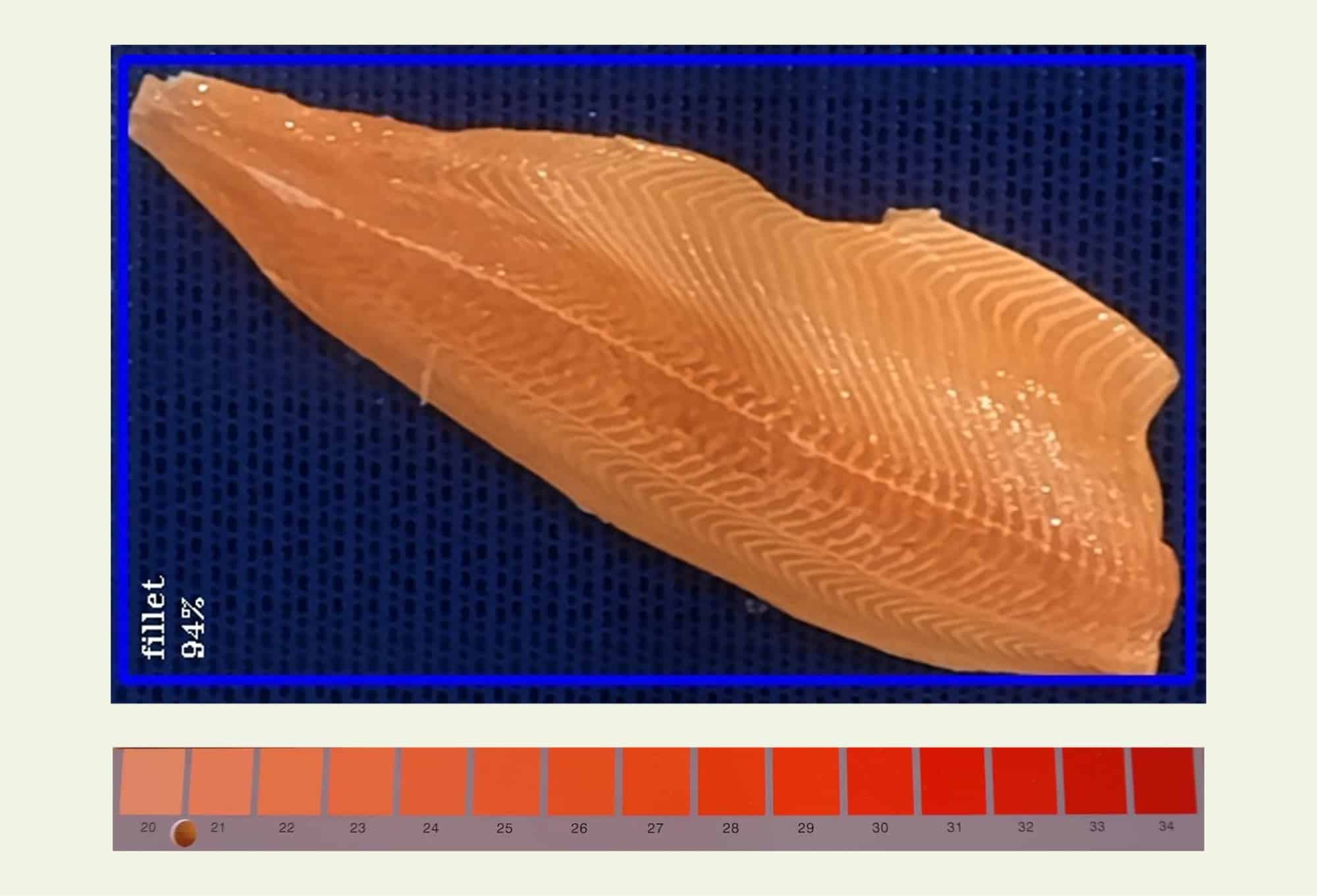
Colour classification is even more challenging for humans. The SalmoFan is a well-established colour scale for salmon. Yet matching a real fillet against a plastic swatch fan is notoriously subjective, particularly when fillets exhibit uneven, blotchy pigmentation. To resolve this, we’ve developed an AI model that quantifies the colour of each pixel across muscle tissue while filtering out confounding outliers such as bruising (brown), melanosis (grey), or belly membrane (white). The result is a consistent, quantifiable classification.
2. From Spot-Sampling to Real-Time, Data-Rich Insights
Most seafood processing plants still rely on statistical spot-sampling, largely because manual evaluation is labour intensive and often physically destructive which adds costs. Consequently, inspectors examine only a tiny fraction of total factory throughput—often less than one percent—before shipping pallets out the door. High-risk defects slip through unseen, leading to expensive customer claims, product downgrades, and damaged brand equity.
Computer vision fundamentally changes this paradigm by turning quality assurance into a continuous, automated data stream. Every product passing underneath a high-speed camera generates images rich with insights: exact length, estimated weight, pixel-level color distribution, classified defects, and more.
When integrated with factory-floor software, this image dataset can link directly to raw material lots, suppliers, fishing vessels, gear types, harvest areas and other data. Processors gain an auditable record of a product’s journey from raw material to finished good. More importantly, it creates operational baselines where none previously existed. Plant managers can evaluate supplier quality objectively, identifying which warrant a price premium and which underperform. AI can even detect subtle trend shifts or anomalies that may signal supplier fraud or mislabeling long before human inspectors notice a problem.
3. From Manual Bottlenecks to High-Speed Automation
Manual inspection is an acute operational bottleneck, especially where inspectors need to weigh and measure each shrimp, squid or sardine, and count the defects. In a typical pelagic plant, for example, an inspector can take upwards of 20 minutes to weigh, measure, and count defects across a single 1-kilogram sample of sardines. Over a standard shift, one technician might inspect just 24 kilograms, a negligible percent of total daily production. An AI vision system can complete the same multi-point inspection in seconds, delivering a tenfold boost in sampling speed.
Similarly, inspecting canned goods moving at 180 cans per minute on a production line is physically exhausting for human eyes. By coupling smart cameras directly to automated pneumatic or mechanical sorters, canneries can automate the rejection of defective cans, significantly reducing labour costs while generating rich datasets on quality and overall equipment effectiveness (OEE).
Preserving Humans in the Loop
Embracing AI-enabled visual inspection does not render human expertise obsolete. While machine vision excels at rapid pattern recognition and continuous measurement, human judgment remains indispensable for annotating images, model training, auditing edge cases, and triggering food safety recalls.
What AI provides is a quantifiable objectivity that quality control processes have long lacked: replacing inconsistency, inefficiency and sampling blind spots with continuous, consistent, and accurate inspection data. In doing so, AI may deliver quality control that is faster, better and substantially more cost-effective.